common on the higher end models of Ovation.
TAMA TG120
Those who are inspecting all my blogs must have been aware
about the tradename Tama displayed on my Orozco blog as
well. I've stated there that the Orozco, Kohno and Sakurai
classical guitars for the world market have been produced in
the TAMA workshops. TAMA also produced classical
guitars under their own brandname. These guitars do
resemble the earlier mentioned brands a lot. This is the
further developement of their Martin D28 copy. Where
possible they adjusted some features to conform it more
according to their taste and provided this model with
another head that has no resemblance anymore with
Martin. Except from the scratchplate all parts are made
from genuine wood parts. Top of solid Alpine spruce.
This guitar came to me in this brand new case. The former
owner inherited this instrument from his brother and
was careful with the guitar as well! Most likely from 1978
as the number system is as follows: first number 8 means
197(8) second and third: the month (12) fourth and
fifth: the day (03) and last three digits: example number.
This numbering system also can be found in the Juan
Orozco guitars of that time. They're from the same factory!
Solid rosewood back and sides, maybe a bit
dull but remember that wood figured this way
is less prone to cracks while wildly figured pieces
of wood tend to possibly give more problems.
The completely written brandname "TAMA" has disappeared
on this model but a tasteful mother of pearl inlaid "T" really
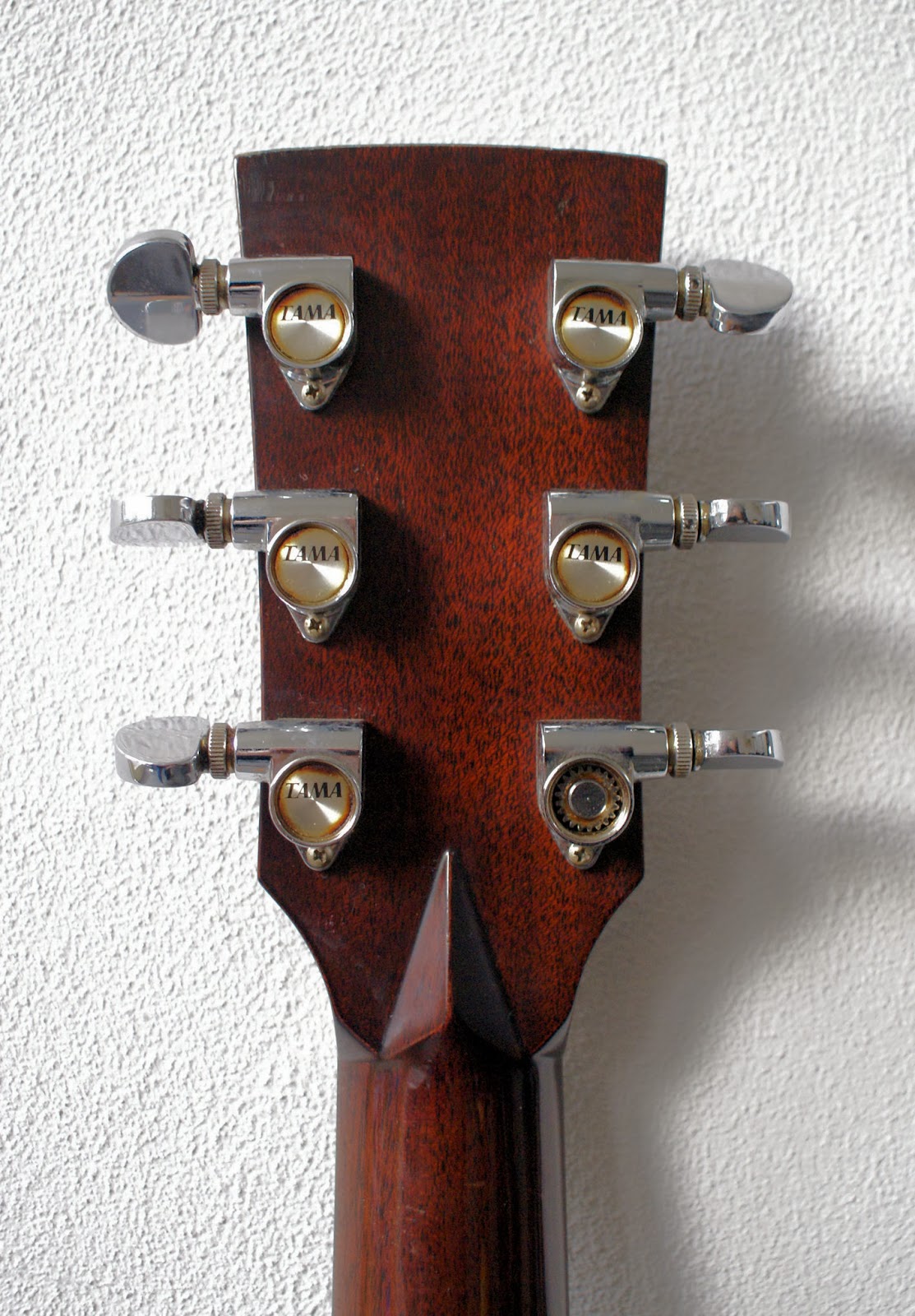
does the job. Grover look alikes as tuners. In fact a bit of
uncommon looking Gotoh's.
The volute in the same manner as the first batch of Ibanez
Artwood series 1 have been provided with. Tasteful!
The overall craftsmanship on these instruments is
really marvellous. Premium materials, good fret and
glue work. Close grained solid top and ebony bridge
and fingerboard. The inner struts seems to be hand
carved which explains the total refinement.
I've included this detail as alongside the bindings 4 layers
of different colored wood have been placed. Believe it
or not: only 0,3 mm thick! They used the same strips
in the circles around the sound hole. By clicking
on this picture you are able to study it.

Besides the numbers that are branded in the heel block,
the label is small but clearly says TG 120.
And then the sound:
Lots of volume but the refinement in tone is there as well.
Just slightly different from my Martin D28 but no less!
It is all about that silky tone most Martin guitars have as well.
Need a top sounding dreadnought at an affordable price?
You should really consider these guitars if you can
lay your hands on them…..
TAMA 3558S
This dreadnought is an earlier example of one of the
Tama products. The details are in fact all a bit less
than on the TG120 guitar. The gluing and further
set up of the woods such as modeling of the braces
have been done with the same care!
In fact that is where the master craft of the Japanese lies:
Veneering back and sides and make it look like a real
gorgeous soundbox. Abalone inlay for the sides and
abalone markers for the fingerboard as well. One remark
really has to be made regarding the veneered sides and
back as the inner layer is made out of the same wood
species: sometimes apparently from more than two
pieces of wood (back) but the Japanese factories did
not do this only for economic reasons: While exporting
to foreign countries these laminated parts hold up
better and to be honest: Jose Ramirez also laminated
his sides in his premium class 1 guitars.
There are several differences in building up these guitars:
3558S versus TG120. In the 3558S type announcement
the S stands for Solid which means a solid top.
To our opinion the necks have been made out of different materials:
The TG 120 has that beautiful mahogany while the neck of the 3558
looks more like a stained Nato one. Though he Hufschlag site states
otherwise. The fretwork is of a lesser quality than on the TG120 so
I replaced the frets with ones that have more "material" and are a
bit higher. To enhance the transport of the string vibration from
the frets to the neck I used glue in the fret slots. Besides that I
securely placed the top nut for better contact with the wood of the
neck. It gave a significant better response of the lower strings.
I really do like the Martin copied head the 3558S possesses.
The tuners have been copied from Schallers / Grovers but they work
really smooth. An extra plus is the truss rod on these guitars.
The nice volute they've added on the later produced 3558
and the TG 120 is not yet present on this model.
Nice inlay work but the fret jobs could have been done
better on these guitars. One of the only minors that even was
there after labeling these guitars with the Ibanez brand!
I like these branded stamps! Serial number and
type number are branded in the inner heel block.
Some claim these earlier Tama guitars as being less
loud and not that sparkling as the later models.
I must say this is not my experience! Lots'
of overtones and volume!
Tama 3551 Classical Guitar
Presented here is the Tama 3551. These number codes were
in use before the later model names such as 8, 10 and 15.
The Tama plant already made their iconic steel strings at that
time. We will discuss this model as the cooperation between
Masaru Kohno, Juan Orozco and Sakurai started later and
probably some differences between this model and the final
models will come up. Scale: 660 mm Topnut 53 mm.
A remark should be made here as my Juan Orozco model
nr. 10 has a scale of 650 mm. The scale held at 660 mm
could be a typical Masaru Kohno move. According to AI
all Juan Orozco models were equipped with a 650 mm
scale. The longer scale was in fact popularized by the
Jose Ramirez 1A guitars that even were 665 mm.


What immediately was strange to me is the mentioned price
for this model 3551 when compared to the later 8, 10 and 15
models. I used the so called unofficial Tama site, sometimes
better known as the Hufschlag site: An interesting source!
http://www.hufschlag.info/html/tama_main.html
This 3551 model was in January 1976 priced at 1258 DM
in USD 595,- The model 3552, at first presumably higher
in rank, was listed for USD 275,- And to make it complete,
the models 3553, 3554 and 3555 were listed at USD 245,-
USD 275,- and USD 295,- Conclusion can be that this
model 3551 was their highest model at that time. In fact
the roses engraved tuners with the butterfly buttons are
pointing in the direction of the later models 10 and 15.

Consulting AI, they gave up the story that when the collaboration
between Kohno, Orozco and Sakurai took place, production methods
were "streamlined" in order to speed up processes and thus make
more profit on still a very good product. We will discuss further
differences between the Juan Orozco model 10 I have in my
possession compared to the Tama 3551. The remark should be
made that the Juan Orozco model 10 was priced at about 2400
DM in april 1982. Prices in Japan have gone up drastically
in the seventies already.
These tuners were later invariably used on the later Juan
Orozco model 10 and 15. The roses were already there.
The so called "butterfly" knobs on later model 10 guitars
have gone in favor of the more simple smooth buttons.
No differences here between the Tama model 3551
and the later launched models 8, 10 and 15.
The Fleta headform was also a detail that stayed unaltered
into production as are the double ebony layers in the neck.
Later the earlier Orozco headstock has been reintroduced.
Same thing counts for the rosette and the thickening around
the sound hole from the inside. Ebony fingerboard here as
opposed sometimes to what other sites are claiming.
Always a picture here to show the fret wear on this one.
Though heavily played with some slight nail damage,
these frets can serve you for several years to come.
Here the bridge with the slanted sides is presented. I think
the only minor was a probably by the former owner lowered
bridgebone that had a wide contact area with the strings.
The result then is a somewhat dull tone with less brightness
so I've changed that one with a newly made one. As a correct
octave pitch sometimes was a problem with these guitars,
I've placed the contact area closer to the sound hole. I've seen
Orozco guitars with a double bone fitted to obtain a flatter
octave response. That was sometimes a bit of a minor on
these guitars. When you are in the race to buy a genuine
model 8, 10 or 15 JUAN OROZCO or a Tama I would
advise you to check the octave pitch thoroughly
The back that is in pristine condition and solidly
executed in rosewood. The inner surface has been
slightly sprayed. A bit in the Masaru Kohno tradition?
The cooperation between Kohno, Orozco and Sakurai is said
to be presenting these final lattice bracing in their guitars.
This Tama 3551, most likely from 1974 has exactly the
same lattice bracing and the only difference I could find
was that the endblock was glued to the back which is not
the case in my later Juan Orozco nr. 10. Anyway they
made a sort of slanted glue surface on the endblock.
The number on the inner heelblock most of the time gives
the exact date of production. In this case the presented number
is 6045656. There is no logical follow up in numbers as the
series starting with a digit 5 could be from 1974 as well
as 1976. There is a 3550 model registered at the Hufschag
site to be from 1974 with registration number 6045609.
That would be quite close to the guitar here above.
Also the reinforcements for the sides were kept in the later
models for the world market. It is possible that Tama already
copied some ideas of the Masaru Kohno guitars that were
very popular at that time. The sound in fact is a close
copy of these venerable guitars as is the scale.
This way of bracing in fact can't be called an exact lattice
bracing the way Greg Smallman later introduced but it relies
more on the older Spanish bracings. Masaru Kohno learnt
from Arcangel Fernandez in the early sixties. Kohno also
studied with Fleta and probably for that reason honoured
him by adding the typical Fleta head.




No comments:
Post a Comment