Translate

Total Pageviews

Wednesday, April 11, 2007

Gibson "Chet Atkins" CEC Nylonstring


Thanks to being produced in 1987 this guitar has
a spanish styled headstock as opposed to the later
addition of the Gibson headstock on these instruments.
I like this styling much more!


The early Chet Atkins models were quite heavy.
With the addition of some more acoustic chambers 
into the body this problem has been solved partly.
Mahogany body with a spruce top. Several examples 
of this type of guitar are having identical problems: a 
dead pick-up. Check the cap for the battery as more 
than often corroding (not visible!) of this part results 
in no 9 volts feeding of the preamp.

Gibson ES 335 TD Semi-Acoustic Electric


This instrument has been built in a period things went bad for guitar
companies. The features on this instrument were too far away from
the original: a volute, coil tap system, block inlay a.s.o.
It has been built with a maple neck, a maple internal block in
the center of this instrument what makes it quite heavy but
the sound is okay anyway and the guitar is very versatile..


The back shows the beauty of the winered colour which I like
on this particular instrument. Still transparent ! This 1981 model
is quite rare as Gibson didn't produce that much ES 335 guitars
during that year. This model was originally fitted with ""Gibson"
engraved tuners that weren't of top quality. I mounted the green
perloid tuners and the tailpiece has disappeared for a stop
tailpiece with micro-tuners that are a very useful addition.

Gibson "Les Paul" custom 1973


The Les Paul model underwent a lot of changes during
it's lifetime. This example has the so called sandwich body
construction. It is not in favour by collectors also because of 
the styling of the maple cap on the body, the volute and 
some other features. Let the guitar speak for itself. This 
one sounds amazing! The name Gibson that has been
stamped in the covers of the pickups is typical for 
the period 1971 -1973. Probably because of the fact
the Japanese companies already copied a lot at that 
time. In English they would say: "The embossed pick 
up covers". The so called witchhat knobs are original.

The tailpiece has been swamped with so called "micro tuners"
Of course I've kept the original tailpiece. Peavey introduced
tone pots on their humbucker equipped guitars that enabled
the pick ups to be split and a single coil sound was made
possible in that way. Can be of course soldered back to its'
original design but it really offers more tonal possibilities.


The back has been refinished with clear laquer as is the neck.
At that time Gibson used some kind of sticky varnish that
didn't influence the ease and comfort of playing in a positive way.
Also the "fretless wonder frets at that time were a disaster to
my opinion. They lowered the frets by filing them down-
wards but never rounded them afterwards! The "waffle back
tuners are present as was customary during this period.

Gibson J 200 / Gibson LG-1 series Steelstring Acoustic

Gibson J 200


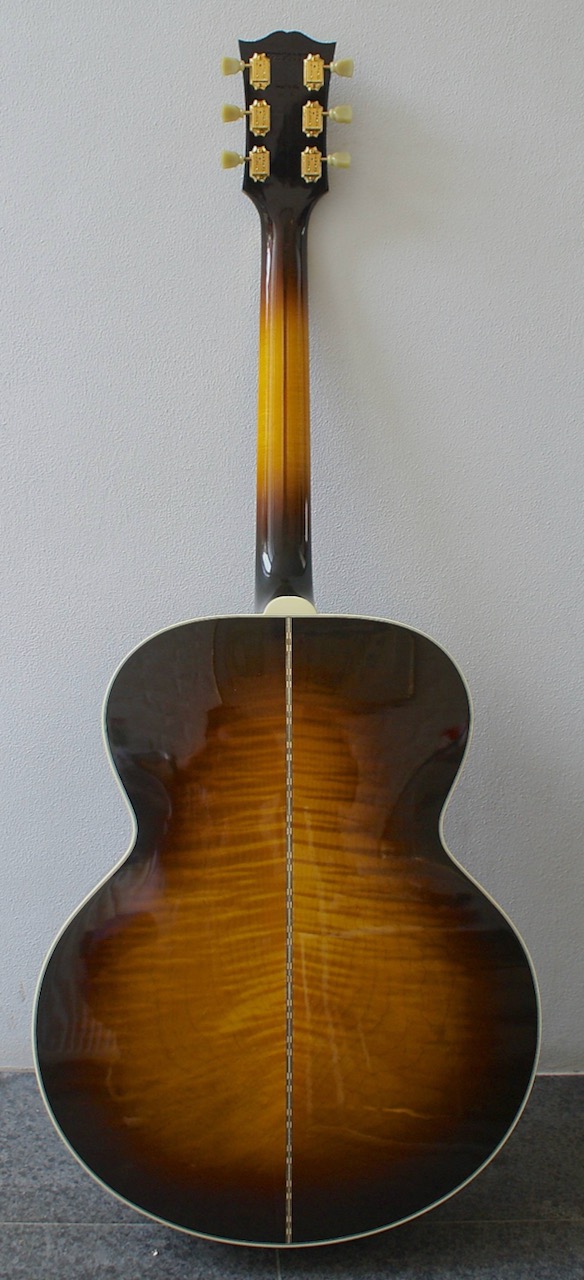
Presented here is one of the flagships from the Gibson company:
the J200. This one dates from 1996 and is equipped with an
X bracing. Furthermore AAA class Sitka spruce top and the
back is figured maple as are the sides. Hardware is gold-plated
and luckily the adjustable bridge and inner brace reinforcement
tone killer of the sixties is gone. The concept still works to my
ears as this instrument has a deep voice with beautiful brilliance
of the higher notes which separate nicely as well so fingerpicking
goes along with strumming on this instrument.


As history replaces the focus especially for younger
players to "younger" instruments.Times weren't always 
well for Gibson as quality control suffered at certain stages. 
We only have to think of the seventies where a lot of 
instruments didn't do justice to the Gibson name though 
there are always exceptions. Noteworthy is for me the 
lesser degree of spraying on the instruments of the last 
decade. I must say: This instrument has no flaws in its'
laquer. The inner woodwork is immaculate as well.
My only critics go to the somewhat roughly finished 
top nut which causes the guitar to get out of tune too
easily. But that can be fixed!


The somewhat older style headstock: Simple but so gracefully.
Note the plain truss rod cover. Sometimes it says: Standard.


A nice shot of the Grovers who carefully copied the older
well known Klusons that were in fact quite mediocre!
But the style as a whole already was there! These ones
do the job! Compared to the instruments of the sixties /
seventies the edges all around the instruments of these
times are somewhat sharper. No problem but I digged the
old way of working more. Machines took over a lot of
jobs formerly executed by the workforce. That results
in a more even kind of quality but it lacks a bit the
personality the older instruments tend to have.


Gibson LG1


The LG-series guitars of the mid sixties were fitted with
a sort of plastic bridge that more than often came off after
a while. On this guitar the bridge has been replaced with a 
rosewood one. The head was cracked and had been 
repaired but still this guitar sounds great for Blues.

This guitar has been refinished. The back and neck 
are made out of mahogany. This LG1 guitar has a 
spruce top with ladder bracing while the LG 0 type
of guitar has an all mahogany soundbox.


I knew there was some repair work on the head that broke 
during transport to Europe. I've kept this one for myself 
and sold the undamaged one as in fact there came 2 LG1
guitars from the USA to the Netherlands.


They partly used the original headstock but I figured it 
to be a lot of work to have that properly done so I made 
a headstock myself. Fine tuning of this reparation only
happens after the gluing work needed.


I wanted some glue surface and besides that extra wood
glued on both sides. That should do the job to my opinion.


I left some space for a kind a veneer layer on both 
back and front of the head. Just to cover things nicely.


Yet unfinished but already glued. Shown here is the 
back of the head.


Here the pictures from both sides. The front also 
provided with a layer.


And to have the original number back on the headstock
is a must to my believe. This guitar dates from 1967. A
real connaisseur will detect these non original prefixes
but I figured it still would be an extra when a future
owner wants to dat this instrument.


I recoloured the neck as well with a waterbased stain
that works very well. You can order it in a small sachet.


The original Gibson logo was lost of course but you
can order a time period correct label at different places.
After sticking it to the head some layers of varnish are
protecting it. And making everything flush is the
final move. Again a guitar for a lifetime!


Gibson SG Special Series 2


This Gibson SG Special has been fitted with P90 single
coil pickups. I particularly like this model of the electric guitar
range made by Gibson. Still in production.
This one's a series 2 model with a big scratchplate and
a wooden veneered, small headstock.
nr. 967155 thought to be out of the year 1969.

This instrument has been refinished with
a kind of pearl like look. Colours differ when you look at
it from another angle. Anyway, the old transparent red
colour came through the new laquer as can be
seen at the headstock. New Schaller tuners added.
They are really great rock guitars!

Guild F 40-M Folk Model Acoustic / Harmony "Patrician" H-1407


This particular Guild guitar made at the end of the seventies
has been a short runned example of the use of stained maple
for the sides and back of this instrument. Not everyone likes 
maple for this purpose but this instrument has a good balance 
and a huge sound. You could say it lacks a bit the Martin 
refinement but that is really personal.


Maybe not clearly visible but at the head the wood
has separated at the place the neck has been reinforced.
By keeping on tightening the truss rod the glue stopped 
working for the neck. This has been the case for more than
20 years, no problem but I will fix it in the near future!


Harmony "Patrician"  H-1407


The Chicago based factory of Harmony made a lot guitars
under the "Patrician" name. This one is the H -1407 but after
they installed an adjustable truss rod. In fact a good move as
at the same time they added a slimmer profile for the neck
that doesn't feel that "chunky'  anymore.


Though some surface damages on the solid soundboard
I'm planning to keep it that way. The pickguard is still
there but a small piece on top of it had broken off due
to the screw that has been overtightened a bit.


The guitar must have had some accidents as the tuning
axles for the D and G string are bent. I solved it by at
first heating the plastic knob with a hair dryer and then
heating the axle with a soldering gun and then gently 
bowing it back. But they are mediocre so they will be
replaced.


There are some problems with the neck attachment but
luckily the neck wasn't tight to the body anymore and
had some give. That makes it possible to inject some
water to release the neck from the body, make a proper
fit and reglue the neck in place while controlling the
neck / body angle at first!


Ibanez "Artist" AR 300 CS Solidbody Electric


My first Jazzguitar was an Ibanez Artist ES-175 copy.
These guitars became quite popular because of the endorsement of
Steve Miller that used one. It was supposed to be the japanese answer
for the Gibson Les Paul. Do not mistake yourself: These guitars 
sound really great and have a very comfortable neck. Built 
around 1981 they had the same body construction as the
Les Paul: Maple on mahogany. Some earlier examples have some
problems with the outer end of the frets: The strings can catched
behind them. A quick solution is to put a slight amount of super
glue along the ends. The cappilary working will do the rest.


What differs from the Gibson Les Paul is the use of a
maple neck though some early Nashville Les Pauls are
also equipped with a maple neck. The specific brass
bridge construction gives them a kind of transparent
sound reminiscent of the way Robben Ford sounds.
D-profile neck. Width at the topnut 43 mm. Scale:
624 mm. Weight: 4250 gram. Super 58 pickups.


The well known headform but a brass metal truss
rod cover plate and a topnut entirely made of brass.
They also delivered this model with a partly plastic
partly brass top nut. The tuners have been changed 
into the small Schaller tuners.


On the back of the head we see a volute as has 
been done in the seventies by Gibson on the Les 
Paul guitars. As for the serial number: The first 
prefix D stands for the month (april) of production 
so A stands for january a.s.o. The following two 
digits gives the year of production: 1981 The next 
four digits are standing for the production number
during that month: 6023. (Source:  guitarinsite)


A clever find, this smooth shaved heelform.


"Built by the proud Craftsmen of Ibanez".